|
|

| Appraisals | Custom Picture Framing | Hospitality and Hotel | ||
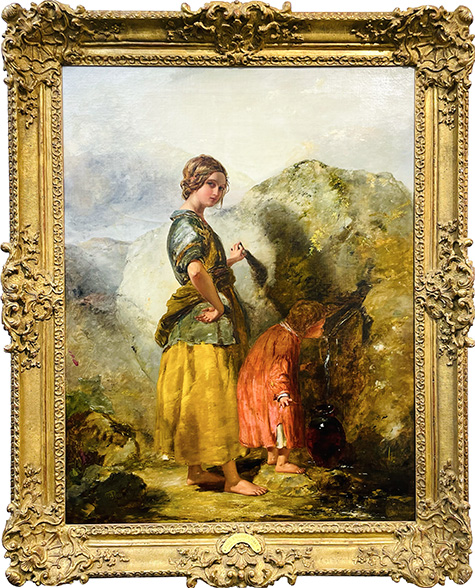
Paul Falconer Poole (1807 - 1879) |
|
Untitled (Two Girls at a Well) oil on canvas dated 1841 54 x 43 1/2 in 137.2 x 110.5 cm framed Please contact us for pricing details |
|
Questions? Please click here to send us an email or telephone us at 780 990 1161 |
Biography Paul Falconer Poole (1807–1879) was an English historical and genre painter renowned for his dramatic portrayals of literary, biblical, and historical subjects, often infused with a poetic feeling for color and composition despite his self-taught background and imperfect drawing technique. Born in Bristol as the son of a grocer, Poole moved to London early in his career, debuted at the Royal Academy in 1830, and became a regular exhibitor there from 1837 onward, eventually earning election as an Associate of the Royal Academy in 1846 and a full Academician in 1861. Poole's early works featured idyllic genre scenes, such as The Emigrant's Departure (1838) and By the Rivers of Babylon (1841), which showcased his fine poetic sensibility. He gained widespread recognition in 1843 with Solomon Eagle exhorting the people to Repentance during the Plague of the year 1665, a luridly lit dramatic composition inspired by Daniel Defoe's History of the Plague, which won him the Heywood gold medal from the Royal Manchester Institution in 1845. Throughout the 1840s and 1850s, he produced notable historical pieces like The Visitation and Surrender of Syon Nunnery (1846), Edward's Generosity to the People of Calais during the Siege of 1346 (1847, awarded £300 in the Westminster Hall competition), and The Messenger announcing to Job the Irruption of the Sabæans and the Slaughter of the Servants (1850), blending moral and narrative depth with tawny gold tonalities. In his later career, Poole continued to explore Shakespearean and mythological themes, including The Last Scene in King Lear (The Death of Cordelia) (1858, now in the Victoria and Albert Museum), The Escape of Glaucus and Ione, with the blind girl Nydia, from Pompeii (1860), and Ezekiel's Vision (1875, bequeathed to the National Gallery). He also ventured into watercolors, becoming a member of the Institute of Painters in Water-Colours in 1878, and exhibited works like May Day and Imogen before the Cave of Belarius in his final year. Poole died at his home in Hampstead on 22 September 1879 and was buried in Highgate Cemetery, leaving a legacy of over 45 known artworks held in major UK collections, including the Royal Academy and Manchester Art Gallery. For a complete biography please click here to visit the artist's page on Grokipedia.org. |
Contact Questions? Please call 780 990 1161 or email mail@landogallery.com |
© Lando Gallery Images and descriptions used on this site are original copyright material and are not to be reproduced without permission. For further information telephone 1 780 990 1161 |